





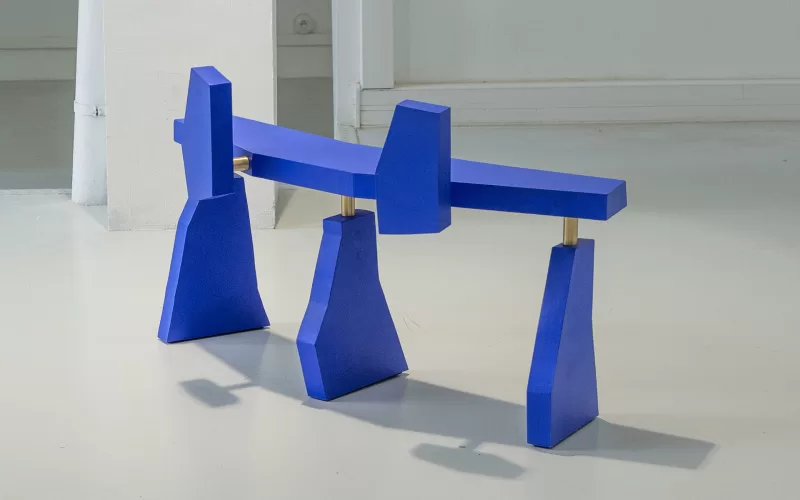
Freshly graduated from the Design Academy Eindhoven, Paris-native Vincent Decat‘s work strikes a unique balance between functionality and spontaneity. His design practice spans across different mediums and forms, allowing his identity to shine through as he challenges the role of interior objects within the context of time and space. In this interview we talk about The Last Bench, a piece in his series The Ruins of Delphi. Inspired by the Athena Sanctuary in Delphi, Greece — a symbol of enduring resilience and timeless strength — the Last Bench embodies the spirit of its final remnants.
How do you balance functionality and artistic expression in your work?
Vincent Decat – It shifts depending on how much emphasis I want to put on the story. For this bench, evoking the sanctuary’s atmosphere at first glance became a focal point. However, functionality remains essential and will always be just as important as aesthetics.
How has your upbringing and education influenced your work?
Vincent Decat – As a child, I wasn’t very exposed to the art scene and only had a vague understanding of the design field. When I later encountered unconventional objects, I was amazed by how special and unusual they can be. The emotions I experienced in these moments are precisely what I want to create for others with my work.
What drew you to the Athena Sanctuary in Delphi as a source of inspiration?
Vincent Decat – While browsing through a book in my school library, I came across a photograph of the Athena Sanctuary. I was looking for monuments with a unique aura, and this sanctuary stood out to me. It has been in ruins for thousands of years now, but it’s still so mesmerising. This photograph made me want to tell its story and to interpret it into a series of objects.


Are there specific elements of the Athena Sanctuary that you’ve incorporated into the design?
Decat: I was particularly inspired by the ruins of the original columns. Each stone, when looked at individually, has its own unique presence. I was more interested in their overall essence than their precise shape, and that’s what I incorporated into my series.
Could you tell us a little bit about the design process of the bench?
Decat: I experimented with different wood silhouettes until I achieved the stone-like quality I was aiming for. My process begins with paper sketches, which I then refine digitally. The bench’s distinct feature is its curved seat, designed to echo the circular arrangement of the monument’s stones. Given that functionality is a core principle in my work, I looked for a balance between the raw aesthetic of the sanctuary and its practical use. The bench was crafted from hand-cut wood pieces, with two layers glued together for added thickness. Each part is assembled and finished by hand.
How do the materials used (wood and steel) reinforce the idea of resilience and timeless strength?
Decat: The wood is crafted to mimic the raw aspect of the monument’s stones. The resilience aspect of the piece is achieved through the thickness of the wood and the way it’s cut. I intentionally avoided using large machinery to achieve more spontaneity and randomness in the shaping process. The matte finish preserves the raw, stone-like appearance, while the metal elements elevate the form — giving it a more airy quality. I needed a contrast in terms of material, colour and finish to make the wood stand out, which also adds a touch of elegance to the piece.

