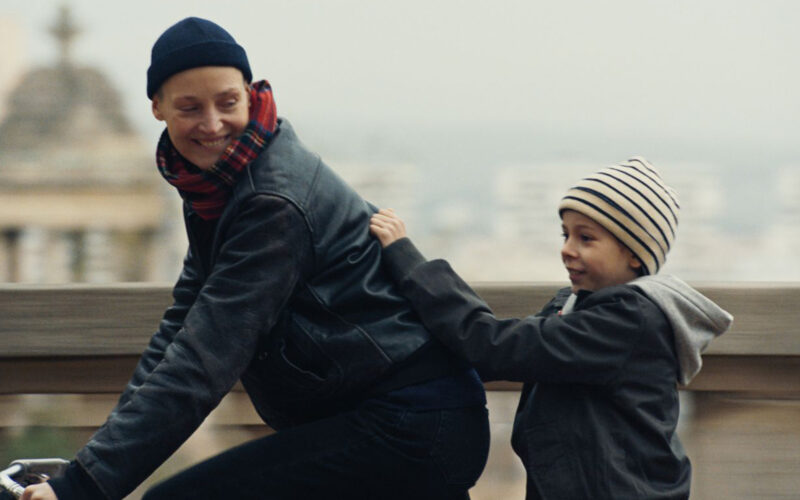
Director Anna Cazenave Cambet returns with her second feature, Love Me Tender, adapted from the novel of the same name by French writer Constance Debré. The film explores the tension between liberation and discipline, intimacy and systemic violence. Its protagonist claims her freedom as far as she can, yet remains constrained by rigid social norms and a dysfunctional French institutional system to which she is still forced to submit.
Forty-year-old Clémence (Vicky Krieps) has left her career as a lawyer, begun writing prose, moved out of the family home, swims every morning without fail, and shares custody of her eight-year-old son Paul (Viggo Ferreira-Redier) with her still legally married husband, Laurent (Antoine Reinartz). Life appears to settle into a fragile equilibrium—until Clémence tells Laurent that her emotional and sexual life is now focused exclusively on women.

She rejects her marriage, the security of bourgeois life with her husband and son on Paris’s Left Bank, and her established career as a criminal lawyer. Motherhood, however, is not something she renounces. Instead, she insists on being a mother on her own terms.
As a former criminal lawyer, Clémence knows how easily a woman who steps outside prescribed roles—especially a mother—can be cast as the villain. Her decision to leave, to write candidly about her lesbian experiences, and to abandon the stability of legal practice for a precarious, bohemian existence is seized upon by her husband’s lawyer as proof of her unfitness.

Both the novel and the film are set in France after the introduction of Mariage pour tous (Marriage for All). Yet legal reform marks only the beginning of a far deeper transformation—one that must take place within institutions and social attitudes, and that will require immense time and effort.
Laurent, now estranged, begins to erect barriers that prevent Clémence from seeing her son. He files false reports and manipulates Paul until the child no longer wants to meet his mother. Devastated, Clémence attempts to fight back, only to realize that she is up against not just time, but entrenched prejudice and stereotypes. Choosing one’s own terms for life and motherhood, the film suggests, still demands punishment.
For Cazenave Cambet, the film’s first-person voice-over—spoken by Krieps and composed of direct excerpts from Debré’s novel—serves as a structural anchor. “The voice tells us where we are in time, lets us feel time passing, and makes us experience absence, longing, and duration,” the director explains. “Because the story unfolds over several years, the challenge was how to convey time.”
She insists on maintaining a strict chronology, juxtaposing the sluggish pace of the judicial system with the fluid, accelerated time of childhood. “What does it mean not to see your child for three or four months? And then to see them again, changed, transformed?” Court hearings are scheduled months apart; social centres are overcrowded; appointments take time. These lost months—between the ages of eight and eleven—become one of the film’s emotional cores.
Movement is a recurring motif, conveyed through brief, mobile scenes and fragments of the novel. This restless energy stands in stark contrast to the rigid, frustrating procedural discipline of the state. Clémence is constantly in motion: cycling and riding motorbikes through Paris, swimming, taking trains, moving between apartments, having sex, writing, socializing, spending time with her girlfriend (Monia Chokri), and meeting Paul at the social centre. This oscillation between movement and stagnation generates a deep tension, allowing the film to hold liberation and discipline in the same frame, alongside the violence inflicted by an ex-partner, society, and the system.

We experience this tension through a series of contrasts:
- Disciplining oneself in front of judges and ex-partners, knowing that every gesture may be used against you
- Liberating oneself in appearance, through a haircut and a more androgynous, tomboy style.
- Discipline in swimming.
- Discipline in writing, as an artistic necessity.
- Discipline in learning how to behave during supervised visits: asking, “Is it OK if I give him this?” or “Can we talk about that?”
- Liberation in expression—admitting pleasure in sex for the first time, and writing openly about it, even as a mother.
- Liberation in discovering and exploring desire through different female bodies.
- Discipline in calling and texting, even when no reply comes.
- Discipline in keeping an Excel spreadsheet documenting missed visits.
- Liberation in ultimately accepting the situation as it is.
Beyond the screen, Cazenave Cambet speaks candidly about the difficulty of making a queer film. Securing financing was extremely challenging, and she describes the sheer effort required to bring the project to completion under such conditions. “It’s wonderful that lesbian films are becoming more visible,” she says, “but we shouldn’t overlook how hard they are to produce, defend, and fund.”
She also notes that three queer films by women directors—Alice Douard’s Des Preuves d’Amour, Hafsia Herzi’s La Petite Dernière, and Love Me Tender—were automatically grouped together, a comparison rarely made with films by male directors. All three were presented at the Cannes Film Festival. The tendency suggests that the industry still treats queer cinema as a homogeneous category, as if all these films were saying the “same thing,” even when it is unclear what that might be. Still, Cazenave Cambet concludes, “This year shows that there is space for all of us. That, in itself, is progress.”