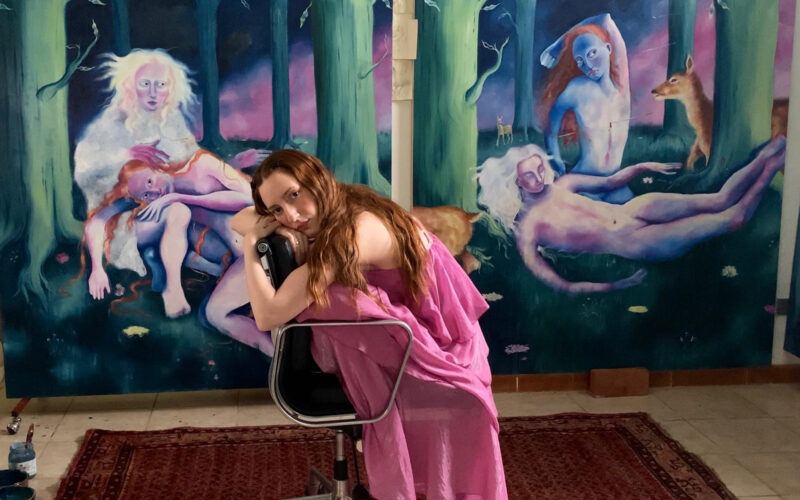
Fairy tales have deep roots in the oral tradition of humanity, and although they began to be written down only from the Renaissance onwards, they are still relevant today. Their symbolism, which speaks to us of transformations and deep emotions, offers a powerful tool for exploring the psyche and human behavior. It is in this fertile ground that Rachele Frison, a young artist from Brianza, works. Her educational journey has been straightforward, but her artistic production is rich and multifaceted, figurative, including painting and drawings. The use of colors in her paintings in particular, plays a key role in creating dreamlike and surreal atmospheres. Her palette is characterized by cool tones such as blue and purple, with delicate touches of pink and yellow interspersed throughout, which create subtle yet effective contrasts.
Fairy tales are the language of the soul. Through their simplicity, they offer solutions to problems that we cannot confront with the rational mind.
Alejandro Jodorowsky
The figures blend into the landscape, their contours dissolving into delicate gradients and fluid transitions of color. Through subtle transparencies and nuanced shading, the composition acquires emotional depth, evoking a sense of dreamlike immersion. This interplay of form and atmosphere transforms the canvas into a visually compelling narrative, where emotions unfold through layers of light and shadow.
In her drawings, a meticulous attention to detail is noticeable, the meditative approach that invites the observer to quiet introspection. The inherent delicacy of the line almost seems to whisper, offering an intimate and direct gaze. While painting allows for the creation of complex and immersive worlds through the power of color and texture, drawing fascinates for its immediacy and ability to tell stories through pure play of light and shadow.
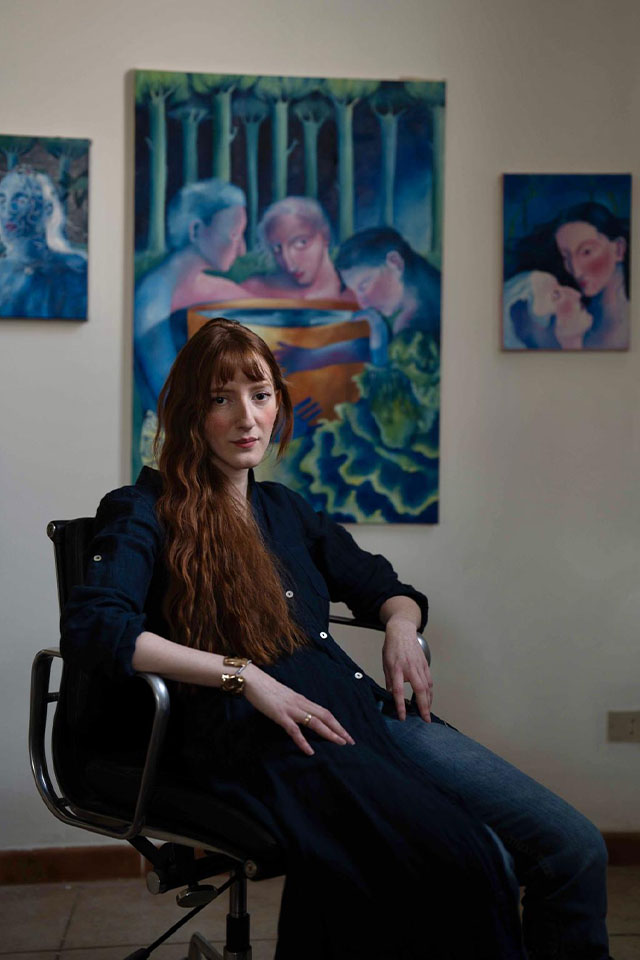
Currently, Rachele is involved in a collective exhibition in Milan, at the gallery Giovanni Bonelli, Sugar Free, with four artists, until the 1st March. Additionally her solo exhibition Bad Moon Rising at the əmerge project space in Pescara, which is on display until February 2nd. This exhibition represents another step in her artistic research, as her art is an ongoing process of evolution.
The themes explored in her early drawings find a new and powerful expression, thanks to the technical maturity Frison has acquired over the years. Her research is not limited to an aesthetic surface but delves deeper, where pathos becomes the driving force of every creation. In this sense, Frison’s painting is never just a visual representation of fantastic worlds; it is a true emotional excavation process that fits into an artistic tradition where symbolism and the dreamlike become vehicles to explore hidden truths of the human soul.
Her works, like the fairy tales of Alejandro Jodorowsky, an eclectic filmmaker known for his visionary and spiritual approach, intertwining symbolism, psychology, and philosophy, speak of transformation and journey. A journey that, while traversing fantastic worlds, has the power to reveal universal and profound truths. Pathos, then, is not just an element that pervades her works, but becomes the key that allows the viewer to connect with the most intimate and universal emotions hidden in each image. For the artist, each new work is not just a creation, but also a self-discovery of her creative desires, enabling her to give life to works that speak directly to the inner world of those who observe them.
What is your first memory related to art? How did you first come into contact with this world?
Rachele Frison – Honestly, I don’t have a first memory specifically related to art, perhaps because since I was a child I found myself expressing myself and cultivating my first ways of communicating through drawing. It was a natural process that followed me through all stages of my life. It’s something I’ve always done and always feel the need to do. My very first memories are related to a lady who had a frame and painting shop next to my mother’s business. I remember sitting in her workshop for hours, drawing horses, another great passion of mine, and I remember feeling at home surrounded by wood dust and paint. As for my early experiences with art as a field of study, I had a very linear and predictable path: I first studied graphic design, then moved to art high school, and finally continued my studies in painting at the Brera Academy of Fine Arts in Milan, where I began to train as a painter.
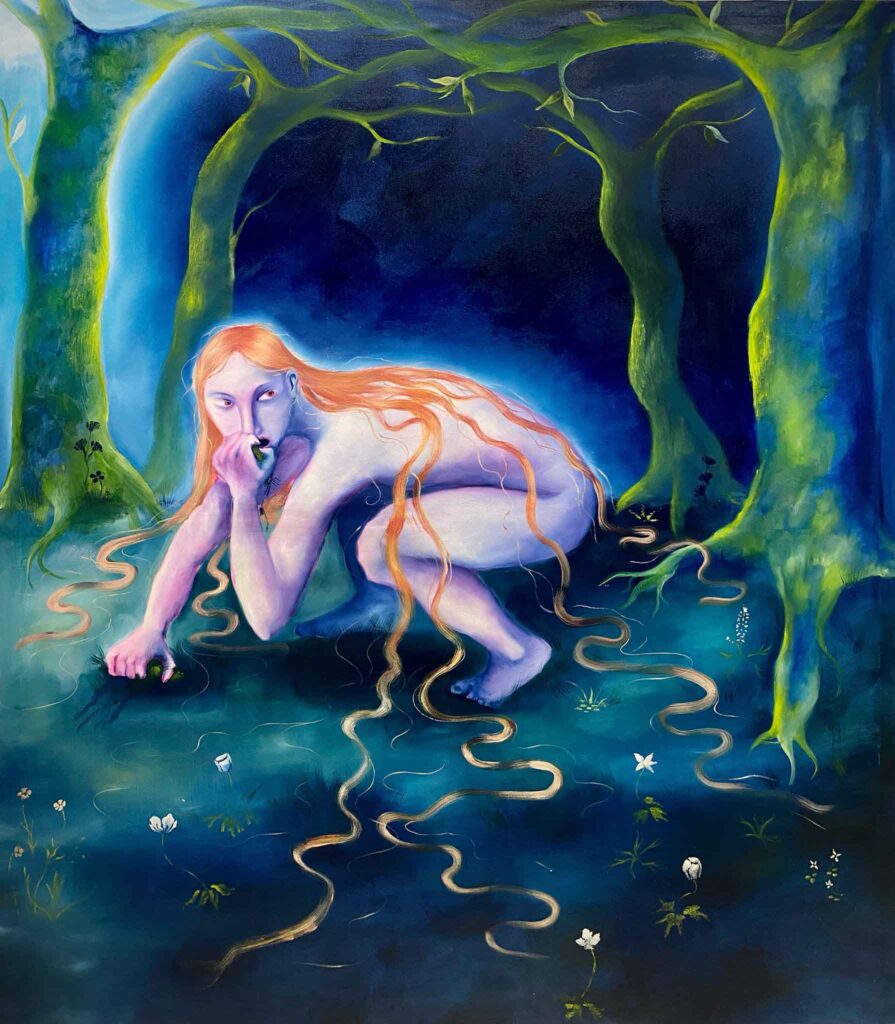
In addition to painting, drawing is also an important component of your practice. Is there a specific criterion you use to decide when to use one or the other?
Yes, drawing is the most important part of all my productions. It’s the language I feel the greatest affinity with and the most expressive capacity [ in her production Frison gives a lot of meaning to the line, that is expressed through hatching] partly because it was my first artistic approach, and also because it has been and still is the longest-lasting since I only started painting a few years ago. To answer the question, I would say that both the drawings and paintings are highly intentional, so from the idea that leads me to create them, I already know what form and medium they will take because both serve different purposes.
You manage to recreate a fairy-tale imagery recognizable in its archetypal figures (fairies, spirits, forest creatures, etc.) while also making your style unique. What do you think helps you maintain this uniqueness?
I’m not sure how to say it, but certainly my genuine interest in these themes leads to an expression that is at least recognizable in terms of content. As for a stylistic signature, I think it is still a work in progress. What I most like about the world of art and painting is that there’s always room for improvement.
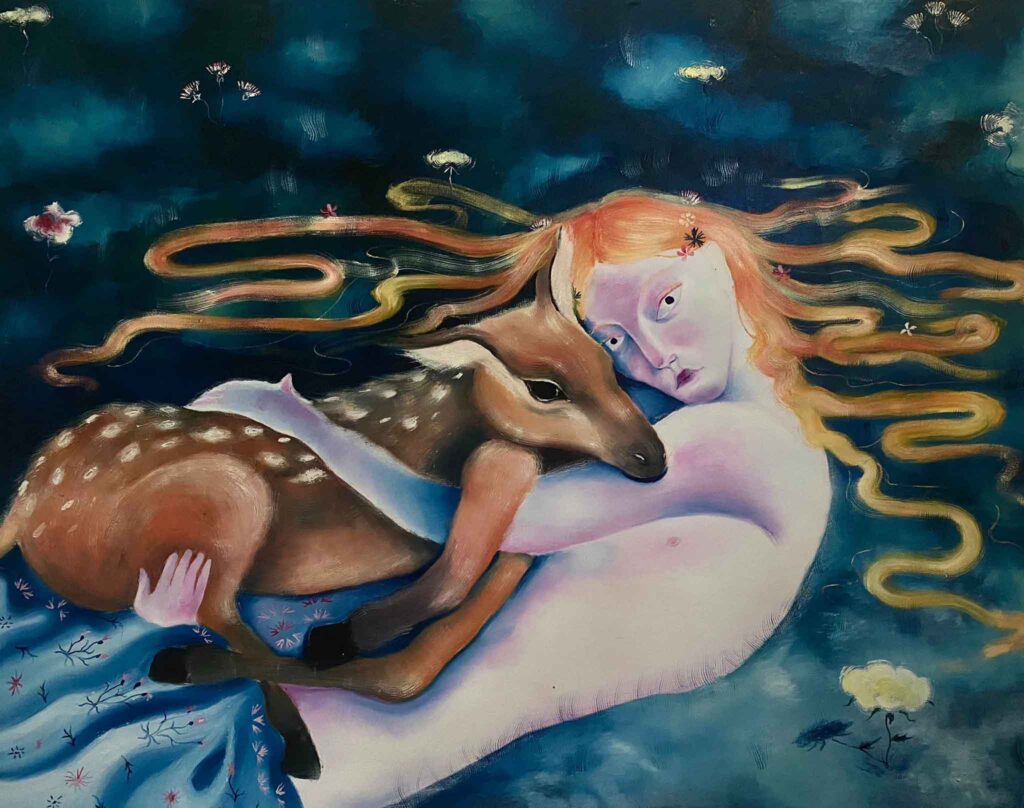
In your artist book Nymphólēptos, you describe your painting as a strangely valid and functional way of expressing the most complex emotions. How does your art help you express what is incommunicable?
Yes, I think that my use of figurative and dreamlike painting is the key that still allows me to address human-related themes, eternal human questions. “Pathetic” themes, full of “pathos,” are the ones that interest me the most at the moment, and figurative painting represents a space where themes such as dreams, love, death, and eternal questions—beyond the values of their time—can be explored.
What readings would you recommend to someone approaching your works, to start from the same imaginative ground?
I think reading fairy tales and stories is the ideal way to engage with my work. I myself often read The Song of Songs, One Thousand and One Nights, from which I freely draw inspiration for stories and also for setting up my paintings, but also Calvino, Shakespeare, and Calasso.
Talking about your solo show “Bad Moon Rising” at the əmerge project space in Pescara, how did you prepare for it? What advice would you give to an emerging artist facing their first solo show?
The proposal for my solo show in Pescara came at a time when I was already working on a solo exhibition, one that hadn’t yet been arranged with anyone but that I knew I wanted to do. So, for this show, I was already working independently from the request, and when the request came, I simply continued working every day until I felt I had reached my idea of a personal exhibition. The idea that the curators embraced was for me to move in the exhibition space with my larger works, created in identical-size modules, to encourage continuity in the space and create the effect of a small forest of stories. The title comes from a song I listened to a lot during the creation of the paintings: “Bad Moon Rising” by Creedence Clearwater Revival, which is a kind of ballad forecasting a bad rising moon. From this, I thought about the influence of the full moon on me and what it might have on my characters, who are seized by a nocturnal madness destined to disappear at dawn. For someone preparing their first show, I would advise them to follow the evolving flow and not be rigid about the initial idea.
What projects do you have for the future? In which direction do you think your artistic research will go?
For 2025, I have two solo exhibitions planned, one in Naples and the other in Pietrasanta, along with some group shows and international projects. I feel that it will be a year full of work, and I’m happy about that. My artistic research is finding common ground with my drawings, and I’m happy with this. I’m glad I listened to myself, my timings, and especially my needs. I felt the need to learn how to paint the way I wanted, only to discover that the themes from my early drawings have returned, and now I have the tools to bring them to life in the best way possible.